
Last updated August 25, 2026
Free on-site gate assessment - hinges, posts, and your LiftMaster or Nice gate operator checked before anything is quoted
The assessment is free and the quote is the invoice.

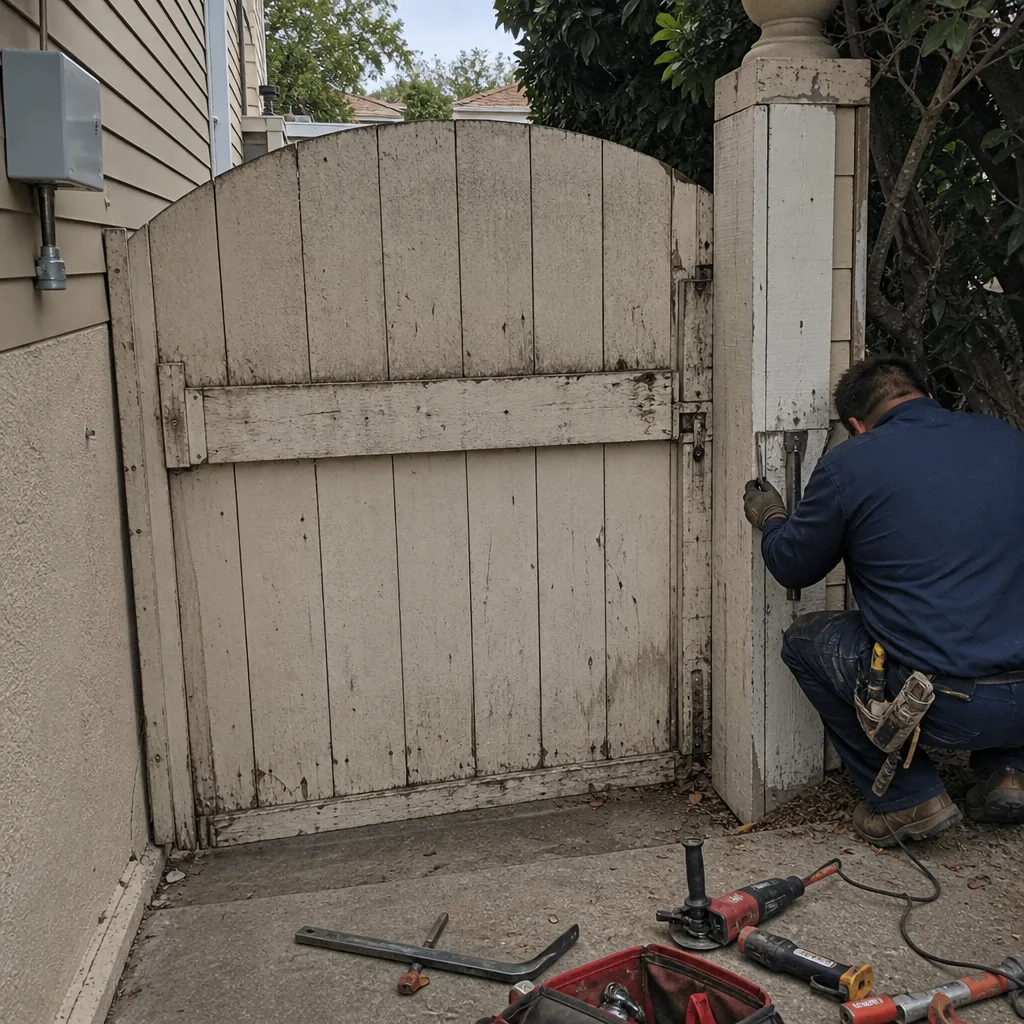 Before
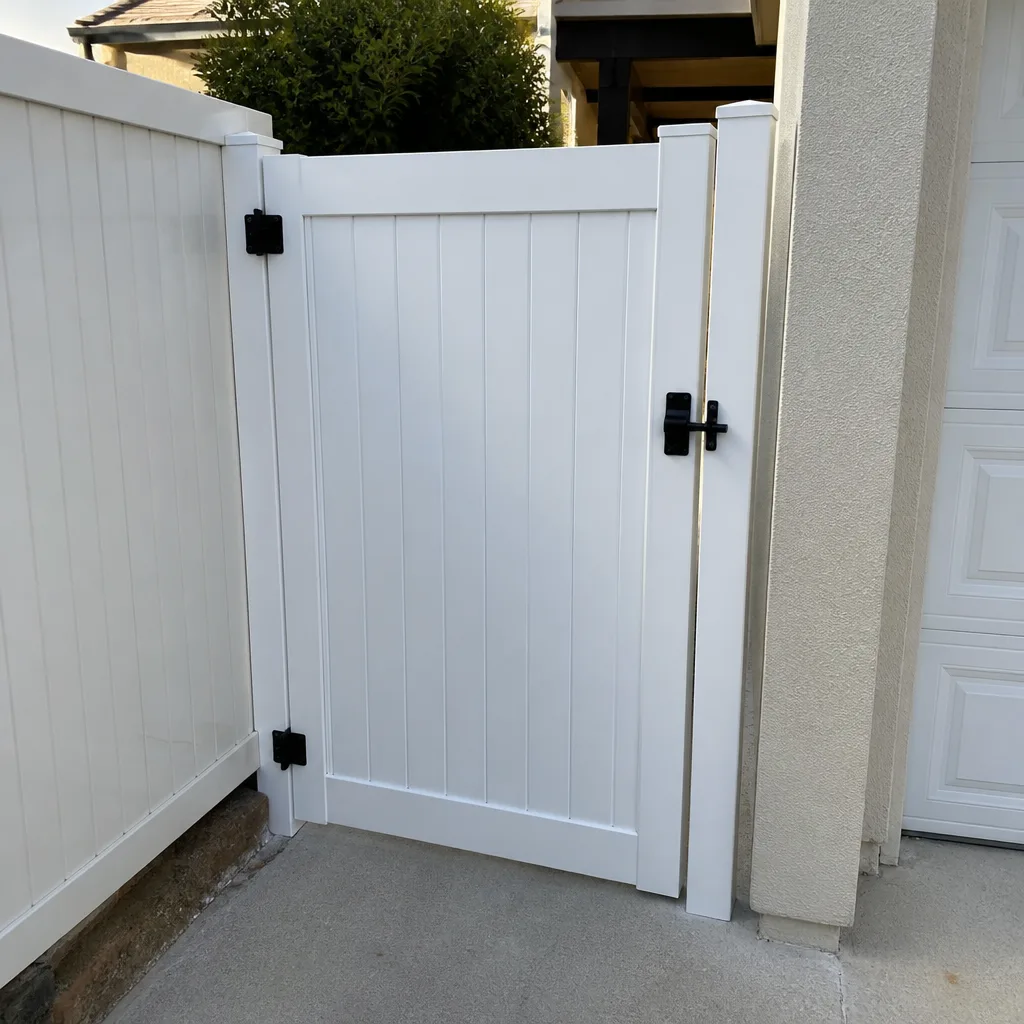 After
After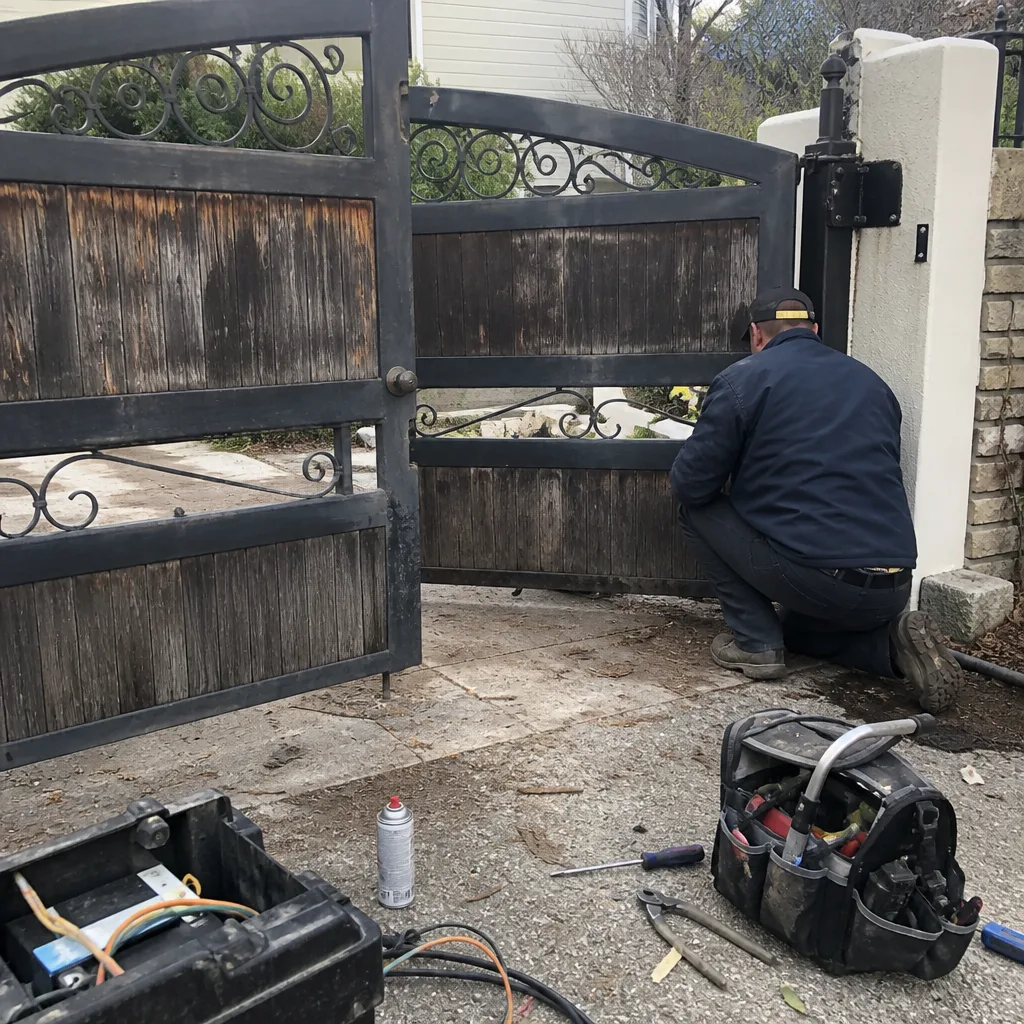 Before
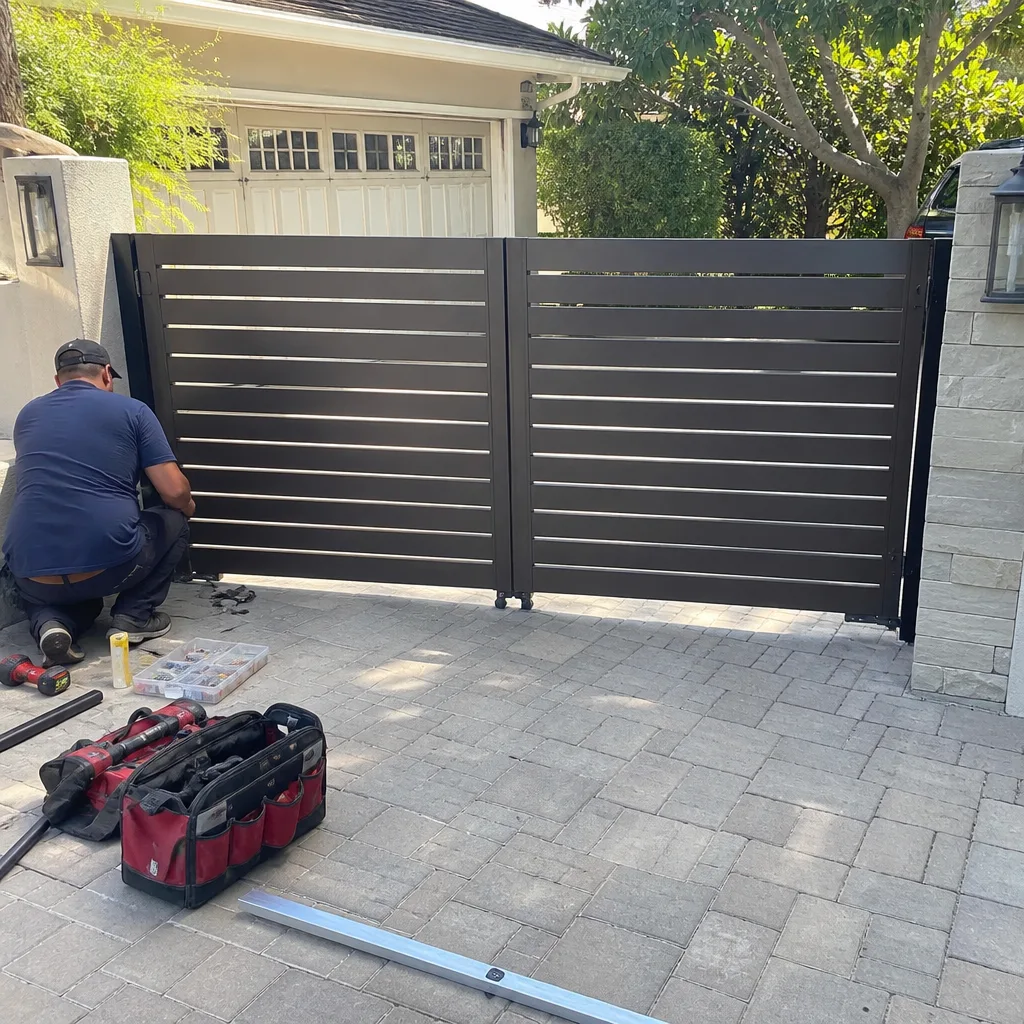 After
After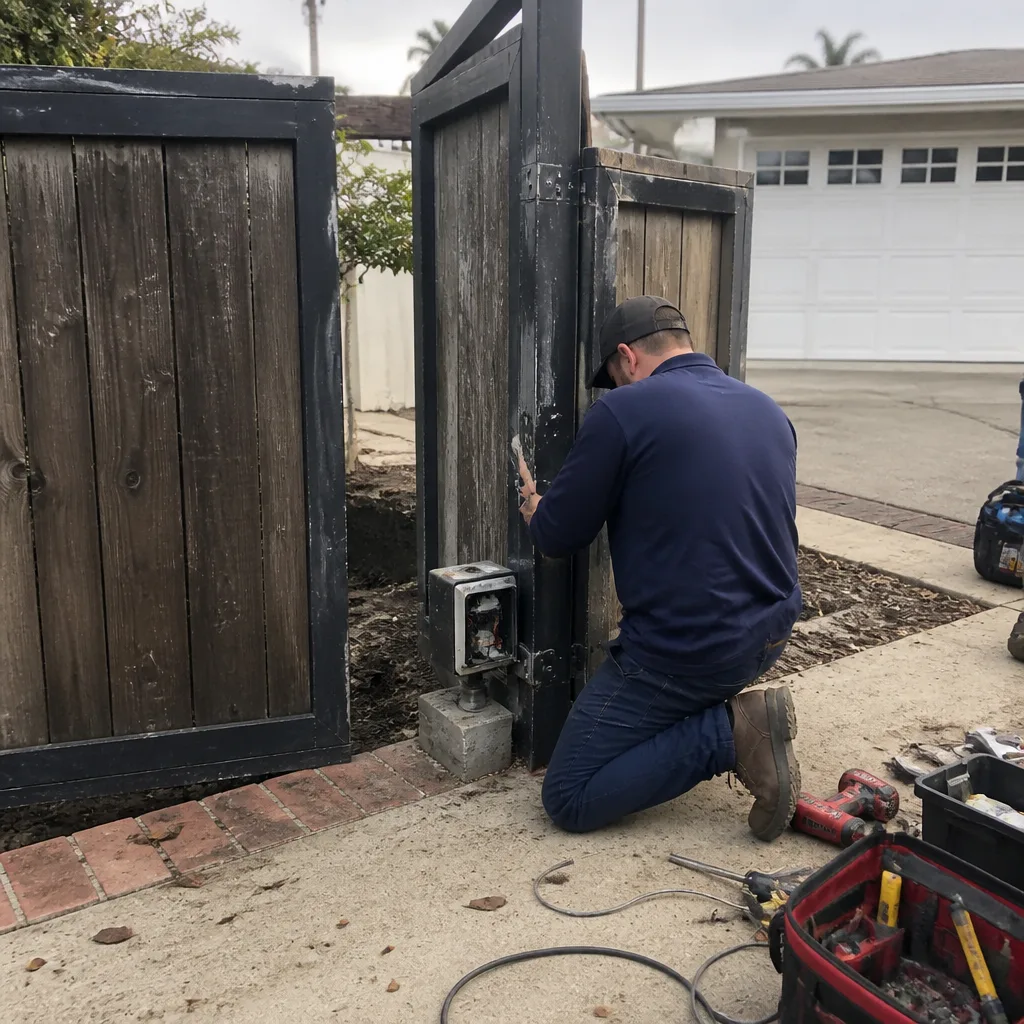 Before
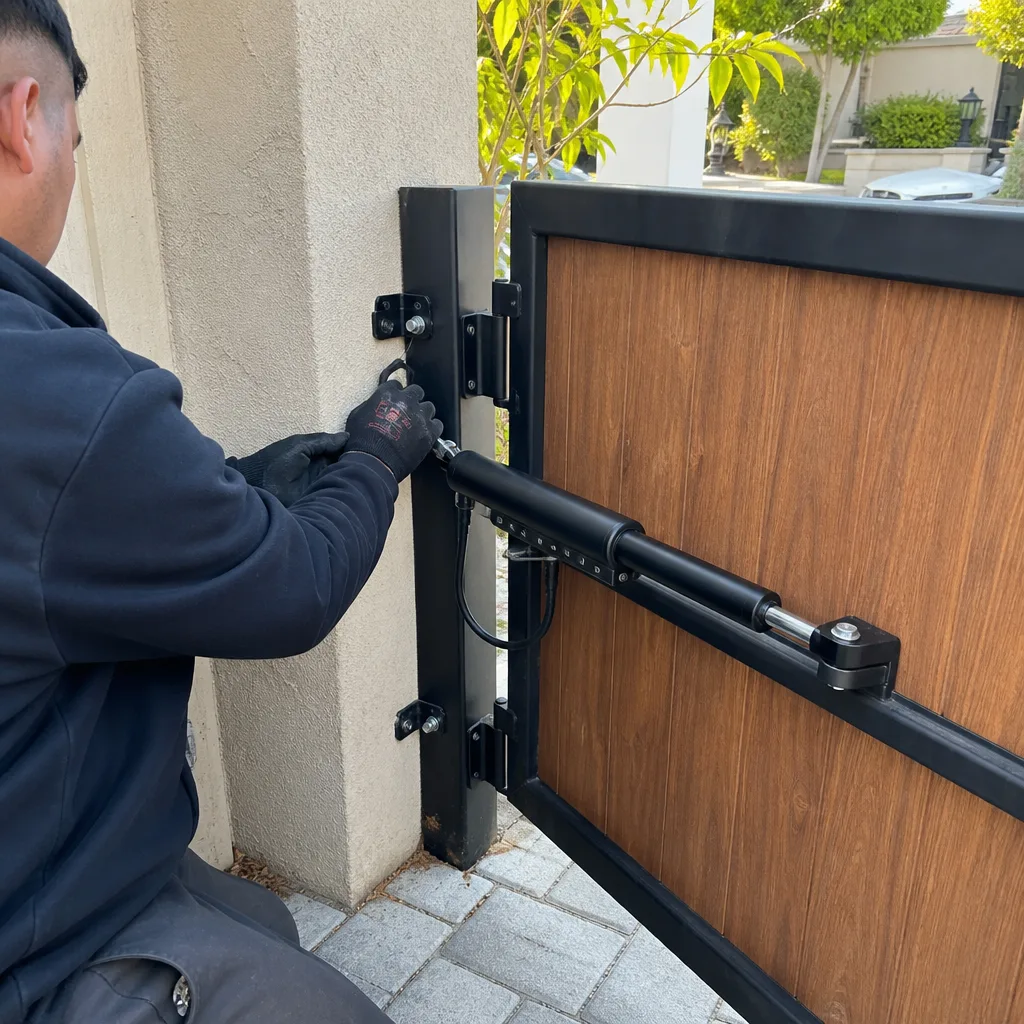 After
AfterDIY vs Professional Gate Repair: The Newport Beach Homeowner’s Decision Guide
A gate that won’t open isn’t just a broken machine. It’s the first thing you touch when you leave and the last thing you touch when you come home. Newport Beach homeowners live with gates that fight salt air, coastal fog, and the occasional earthquake tremor, all while carrying multi-hundred-pound steel panels on hinges that never get a day off. This guide answers the question every homeowner eventually asks: which repairs can I handle myself, and which ones need a trained hand? By the end, you’ll know the difference between a can-of-grease fix and a load-bearing liability.
Quick Answer
Most cosmetic and basic maintenance tasks, like cleaning rollers, tightening visible bolts, and lubricating hinges, are safe DIY work. Repairs involving torsion springs, opener motors, control boards, or any load-bearing hardware should be handled by a professional gate repair technician in Newport Beach, because a failed spring or a miswired opener can turn a 400-pound gate into a serious hazard.
Table of Contents
- Understanding the Risk: Why Gates Are Different
- What You Can Safely Do Yourself
- What Should Stay With a Pro
- Cost Comparison: DIY vs Professional in Newport Beach
- The Newport Beach Factor: Salt Air, Slopes, and Sensors
- Common Mistakes to Avoid
- When to Call a Professional
- Frequently Asked Questions
Understanding the Risk: Why Gates Are Different
An automatic driveway gate is not a fence with a motor bolted on. It’s a moving steel structure that often outweighs a small car, driven by a motor that can push with surprising force. In Newport Beach, many estate gates run on track systems embedded in brick or stone columns, and those columns hide the parts that hurt people: torsion springs wound tight enough to lift hundreds of pounds, chains under tension, and low-voltage wiring that can still arc if handled wrong.
We’ve seen what happens when a homeowner unwinds a spring without the right tooling. The spring releases its stored energy in a fraction of a second, and the bar that was holding it becomes a projectile. It’s not a matter of strength; it’s a matter of how the energy is contained. A trained technician knows how to read the wind direction on the spring, how to secure the gate panel before unbolting hardware, and how to check that the opener’s force settings are in sync with the gate’s weight. None of that is visible from the outside.
That said, not everything on a gate is dangerous. The distinction matters because overpaying for a pro to squirt grease on a hinge is as foolish as underpaying a handyman to re-tension a spring. The next two sections draw that line clearly.
What You Can Safely Do Yourself
Homeowners in Newport Beach can keep their gates running well between professional service visits by handling a handful of low-risk tasks. These tasks share three traits: they don’t involve stored mechanical energy, they don’t require removing load-bearing hardware, and they don’t touch the electrical system.
Safe DIY tasks for most homeowners:
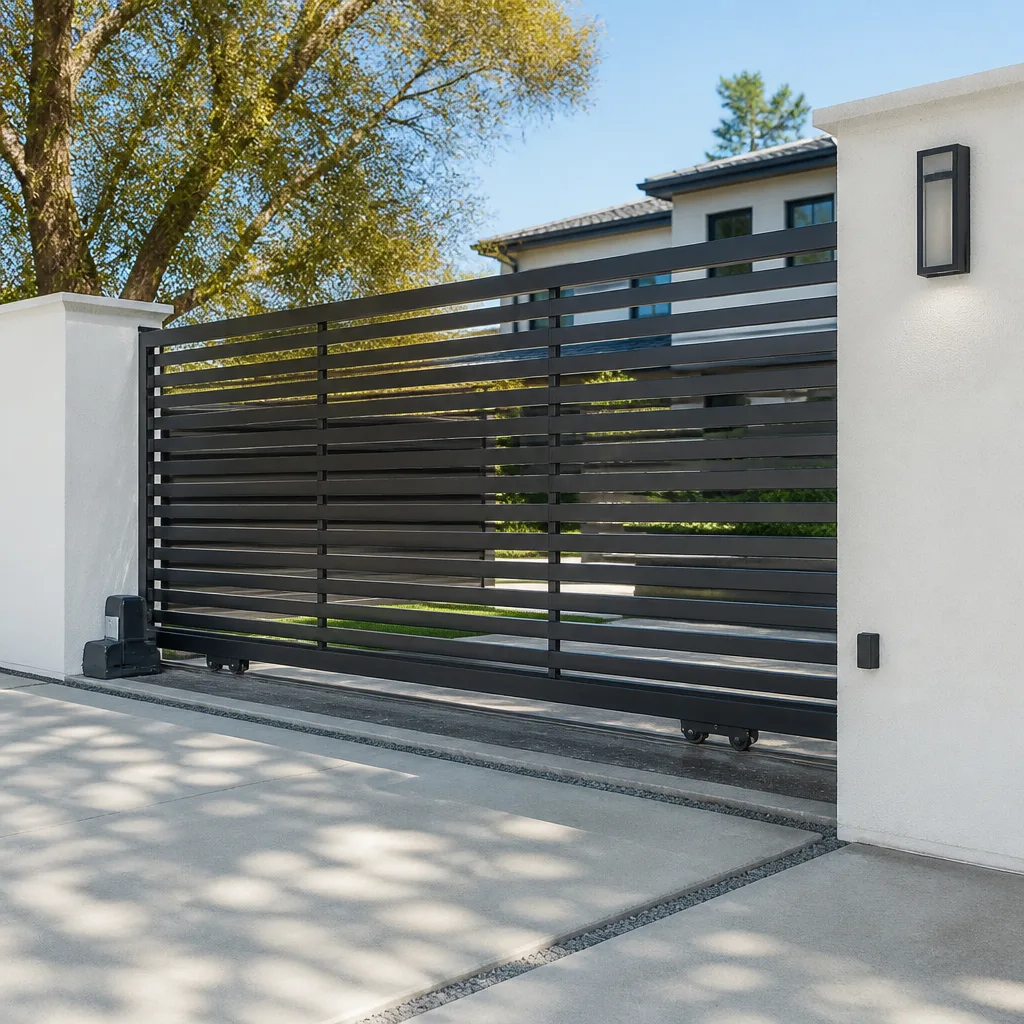
- Cleaning the track and rollers. Dirt, leaves, and coastal grit build up in the bottom track of sliding gates. A stiff brush and a shop vacuum handle most of it. Do this every three to four months in Newport Beach, more often if you live near the water.
- Lubricating hinges and wheels. Use a silicone-based or lithium-based spray lubricant. Avoid WD-40, which attracts dust and dries out. Apply to hinge pins, wheel bearings, and the top track every six months.
- Tightening visible bolts and screws. Gate movement works bolts loose over time. A socket set and a few minutes can catch minor looseness before it becomes a bigger problem. Never tighten bolts on a gate that’s mid-cycle under opener force; the panel should be stationary and secure first.
- Clearing photo-eye sensors. The small lenses near the bottom of the gate posts get clouded by salt film and spider webs. A soft cloth with a little glass cleaner restores them in minutes. Realign the sensor if cleaning doesn’t fix an intermittent reverse.
- Inspecting the gate’s movement by hand. Put the gate in manual mode (check your opener manual; most have a release lever) and roll it open and closed slowly. Note any hitches, scraping sounds, or resistance points. That information helps a technician diagnose faster, and it tells you whether the gate’s weight is balanced.
These tasks take an hour or less and cost almost nothing. They extend the life of the hardware and keep the gate moving smoothly while the serious mechanical parts wait for professional attention. But there’s a hard line, and crossing it accidentally is easy.
What Should Stay With a Pro
Certain gate components should never be touched by anyone who isn’t trained. The reason isn’t gatekeeping; it’s physics. The same gate that rolls gently on its track weighs several hundred pounds, and the parts that move it are under tension or current at all times.
Professional-only repairs:
- Torsion and extension springs. These springs store enough energy to lift the gate. Releasing that energy incorrectly is one of the most common causes of serious injury in the fencing and gate trade. A broken spring also means the gate’s weight is no longer balanced, which can damage the opener motor if run even once more.
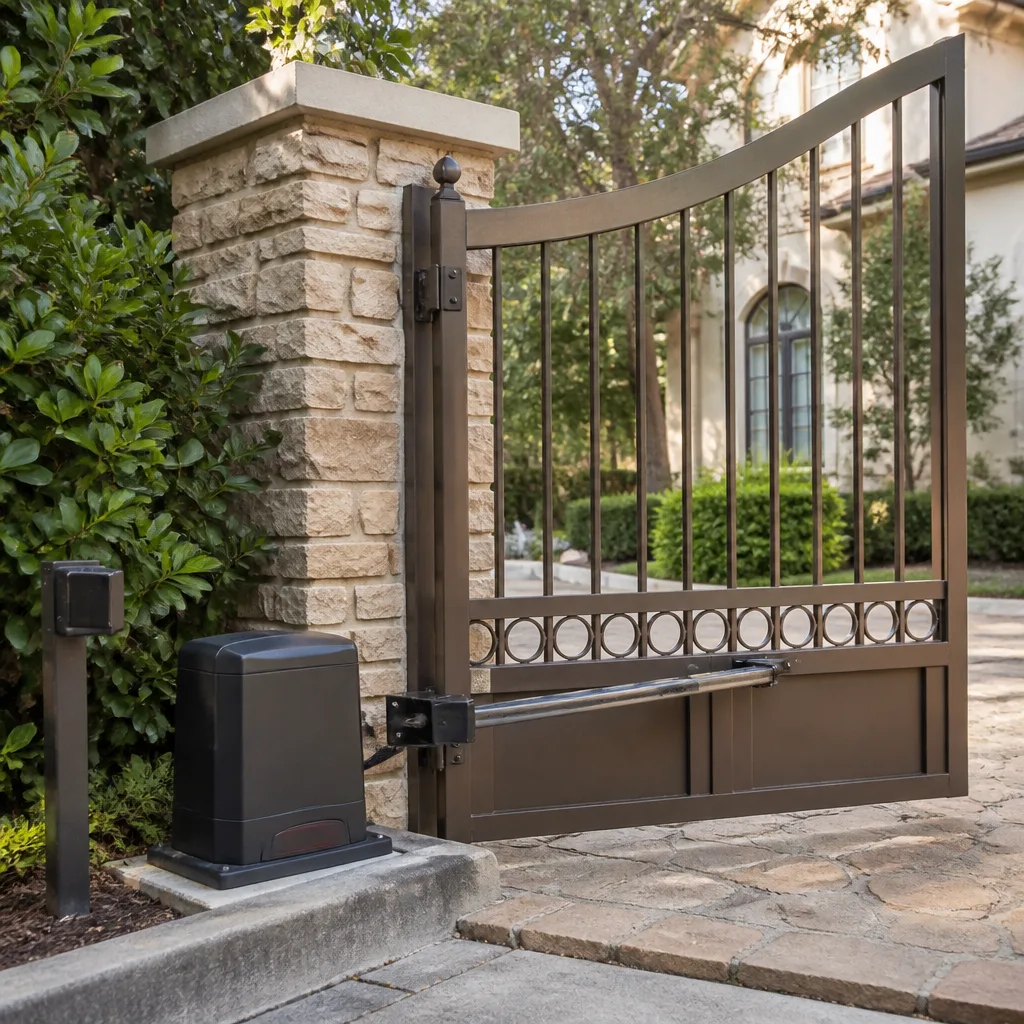
- Opener motor replacement or repair. Gate openers involve a motor, a gearbox, limit switches, and a control board. Diagnosing a dead opener means testing voltage, continuity, and logic circuits. Guessing and swapping parts gets expensive quickly.
- Control boards and electrical wiring. Low-voltage doesn’t mean no-risk. A shorted board can burn out the opener’s transformer or send a surge to your home’s circuit. Wiring repairs require knowing which terminals carry constant power, which carry signal, and which are safety loops.
- Gate panels that have come off their track. If a sliding gate has jumped its rollers or a swing gate has sagged, the panel itself is out of alignment. Forcing it back into place risks the gate falling or the frame twisting. The panel must be supported and re-hung properly.
- Vehicle-loop detectors. The wire loops cut into your driveway detect cars and trigger the gate. Cutting into concrete to replace a loop and splicing the detector wires is a job for a professional with the right saw and sealant knowledge.
- Anything involving the gate’s weight-bearing hinges on a swing gate. Hinge pins on large swing gates wear differently over decades. Replacing them requires jacking the gate safely and welding or bolting new plates. A gate that falls off its hinges can kill.
The safety rule is simple: if the part is under tension, carries current, or supports the full weight of the gate, call a professional. In our experience serving Newport Beach for decades, the most expensive repairs are the ones that started as a confident DIY attempt.
Cost Comparison: DIY vs Professional in Newport Beach
Money is the first thing homeowners ask about, so let’s look at real numbers for the Newport Beach market. These are ranges we see on service calls and parts invoices, not national averages pulled from a website.
| Repair Type | Typical DIY Cost (Parts Only) | Typical Professional Cost in Newport Beach | Notes |
|---|---|---|---|
| Hinge and roller lubrication | $10-$25 | $89-$150 (often bundled with tune-up) | DIY is fine; annual pro tune-up catches hidden wear |
| Photo-eye sensor replacement | $30-$80 | $150-$275 installed | DIY may work if wiring is plug-in; alignment matters |
| Gate opener limit switch adjustment | N/A (requires test equipment) | $125-$225 | Not safe for DIY on most brands |
| Broken torsion spring (single) | $60-$120 for the spring | $325-$550 installed and wound | Includes full cycle testing and balance check |
| Opener control board replacement | $150-$400 for the board | $400-$750 installed and programmed | Wrong board or wiring error destroys new part |
| Gate panel re-hang and realignment | N/A (needs lifting equipment) | $450-$900 | Price varies with gate weight and column access |
| Full opener motor replacement | $400-$900 for the motor | $1,100-$2,400 installed | Includes force settings, safety edge calibration, warranty registration |
The pattern is consistent. Parts are only a fraction of a completed repair. The rest of the professional price pays for the diagnosis, the labor, the testing, and the guarantee that the gate won’t fail in three weeks. When a DIY part fails because it was installed wrong, you buy the part twice and still end up calling a professional. The quote is always agreed before work starts, so there’s no surprise on the invoice.
The Newport Beach Factor: Salt Air, Slopes, and Sensors
Newport Beach is a particular environment for gates. Salt air corrodes metal faster than almost anything else in Southern California. Steel that would last 30 years in Irvine can show rust scaling in 15 in Corona del Mar or Balboa Peninsula. That corrosion affects more than appearance: it eats hinge pins, pits the roller bearings, and creeps into wiring connections until intermittent faults start.
Sloped driveways are common in Newport Coast and the hills above PCH. A gate on a slope works harder every cycle, because the motor is fighting gravity on the uphill run and holding against it on the downhill run. Force settings that work fine on a flat lot will fault out on a slope if the installer used generic defaults. Homeowners who’ve had a gate work fine for years and then start reversing halfway through a cycle are often dealing with a slope-related force-sensor issue, not a broken motor.
Then there’s the fog. Marine-layer nights leave a fine salt film on everything, including photo-eye lenses and keypad contacts. Keypads that work intermittently, sensors that trip for no visible reason, and opener boards that throw random error codes are the three most common fog-and-salt complaints we hear from homeowners in Lido Isle and Balboa Island.
What this means for the DIY question is simple: many generic repair guides online don’t account for a coastal environment. A tutorial that works for a homeowner in Riverside can fail badly on a gate two blocks from the water in Newport Beach, because the corrosion profile and ground conditions are different. Local knowledge isn’t a selling point; it’s the difference between a repair that lasts and one that doesn’t.
Common Mistakes to Avoid
- Using the wrong lubricant. WD-40 is a solvent, not a lubricant. It strips existing grease and then evaporates, leaving the metal drier than before. Use white lithium or silicone spray on gate hardware.
- Running the opener after a spring breaks. When a spring snaps, the gate’s weight is no longer counterbalanced. Running the opener even once forces the motor to lift the full panel weight, which burns out the motor gear. Always put the gate in manual mode and call for service.
- Replacing a battery in the keypad without checking the casing. Salt air corrodes the battery contacts and the rubber seal. If the casing is cracked or the contacts are green, a new battery won’t fix it and moisture will destroy the board inside.
- Tightening every bolt you see on a swing gate. Some bolts on gate hinges are designed to pivot and should not be reefed tight. Over-tightening can bind the hinge and crack the weld over time. If you’re not sure which bolts are which, leave them alone.
- Ignoring a gate that’s getting slower. Gates don’t slow down because they’re tired. A gradual slowdown usually means a failing capacitor or a worn gear in the opener. By the time it stops completely, the repair is bigger and more expensive.
- Buying a universal remote without checking the opener’s frequency and protocol. Not all remotes work with all boards. Newport Beach gates range from 20-year-old FAAC and Viking systems to modern LiftMaster and BFT boards, and a mispaired remote can lock out the existing ones.
- Dismissing warning beeps or flashing lights. Those signals come from the opener’s safety circuit. They mean the gate has hit resistance or a sensor fault has tripped. Clearing the code without finding the cause means the gate may operate unsafely the next cycle.
When to Call a Professional
Call a professional when the gate won’t complete a full cycle without reversing or stalling. Call when you hear grinding, snapping, or popping from the spring assembly or opener gearbox. Call when the gate has come off its track, sagged visibly, or started scraping against the driveway or column. Call when the keypad, remote, or intercom stops working and troubleshooting hasn’t fixed it within an hour. Call when you see exposed wiring or smell burning plastic near the opener. In any of these cases, continuing to use the gate or prying at the problem will make it worse. Ironworks Gate Co. offers free estimates in Newport Beach. Call (760) 852-5601, and a technician will assess the gate and give you a written price before any work begins.
Frequently Asked Questions
Gate repair in Newport Beach typically costs between $125 and $2,400 depending on the part, with common fixes like sensor replacement at $150-$275 and full opener replacement at $1,100-$2,400. The exact price depends on the gate’s weight, the opener brand, and whether the gate is sliding or swinging. Call (760) 852-5601 for a free estimate with the price quoted before any work starts.
Basic maintenance like cleaning sensors and changing remote batteries is fine for homeowners, but opener motors, control boards, and force-sensor adjustments should be handled by a trained technician. These components involve live current and precision settings that affect safety. A wrong diagnosis can ruin a new part and leave the gate inoperable.
Gate openers in Newport Beach typically last 8 to 15 years, with coastal exposure on the peninsula and islands shaving a few years off that range due to salt corrosion on boards and connections. Underground swing gate systems and properly housed slide gate openers tend to last longest. We’ve serviced 40-year-old gates whose original steel is still sound, but the opener rarely survives that long in marine air.
Repair is usually the better choice when the opener is under ten years old and the problem is isolated to a single component like a capacitor, limit switch, or photo-eye. Replacement makes more sense when the board is fried, the gearbox is worn, or the motor is struggling on a gate that’s seen 15-plus years of cycles. A professional assessment takes less than an hour and gives you firm numbers for both options.
Most gate repairs in Newport Beach do not require a permit, because you’re maintaining an existing structure rather than building a new one. Replacing a gate panel or upgrading from a manual to an automatic opener typically falls under maintenance. New gate installations and certain column or foundation changes may trigger the city’s permit process, and a qualified gate contractor will know which projects need city approval.
Most professional gate companies in Newport Beach service the major brands including LiftMaster, FAAC, BFT, Linear, and Viking, which covers the vast majority of residential gates in the area. Ironworks Gate Co. is certified and equipped on nine leading brands, so whatever is on the driveway, the correct fix can be made on the first visit. If a brand is unfamiliar to a technician, that’s a sign to keep looking.
The Bottom Line
A Newport Beach gate is a long-term component of your home. The parts you can safely clean and lubricate will reward you with a quieter, smoother gate and fewer service calls. The parts you can’t safely touch will punish a confident mistake with broken bones, fried boards, or a two-thousand-dollar repair that started as a fifty-dollar part. The smartest homeowners handle the simple upkeep, learn to spot the warning signs early, and keep a trusted gate specialist’s number saved for everything else. Done right, a gate repair is a quiet, boring event. And that’s exactly what you want it to be.
Written by Victor Salinas, Owner at Ironworks Gate Co., serving Newport Beach since 2013.