
Quick Summary
Choosing between a sliding vs swing gate depends on your driveway slope, setback clearance, and long-term hardware durability requirements. Drawing on over 42 years of coastal Orange County expertise, Ironworks Gate Co. explains that sliding gates perform best on steep slopes and space-constrained lots, while swing gates offer a mechanically simpler, cost-effective solution for level driveways. After reading this guide, property owners can evaluate their site grading, calculate precise space clearances, and schedule a free on-site gate assessment for a personalized recommendation and upfront estimate.
Sliding vs Swing Gate: Selecting the Best Driveway Setup
Choosing between a sliding vs swing gate comes down to the physical layout of your driveway, available clearance, and environmental conditions. While property owners often start by comparing initial installation costs, the right choice usually hinges on practical realities: driveway slope, property lines, and how well the mechanical hardware holds up over the long haul.
Site layout and grading play a central role in gate selection. As technicians at Ironworks Gate Co. point out, driveway grade, property setbacks, and weather exposure must be evaluated to pair your layout with a reliable, properly calibrated setup.
Sliding vs Swing Gate: Quick Driveway Comparison Guide
A sliding gate moves horizontally along an adjacent fence line or retaining wall. Sliding gates are often better suited to steep or space-constrained sites where a swinging gate might scrape the pavement. A swing gate opens inward or outward like a pair of front doors, requiring zero ground hardware across the driveway opening, but demanding a deep, clear radius for the gate leaves to travel through.[2]
Both styles offer distinct operational advantages depending on your terrain and how much maintenance you are willing to manage.
| Feature | Track Slide Gate | Cantilever Slide Gate | Dual Swing Gate |
|---|---|---|---|
| Slope Tolerance | Suitable across uphill grades | Effective on slopes and uneven ground | Best on flat or gentle downhill slopes |
| Required Clearance | Lateral run along fence line | Lateral run plus counterbalance tail | Deep radial arc into or out of driveway |
| Debris Vulnerability | Higher (debris collects in ground track) | Lower (suspended above the ground) | Lower (hinges mounted off the ground) |
| Routine Upkeep | Clearing track debris | Roller alignment and bracket checks | Hinge greasing and post plumb checks |
Key Differences at a Glance
Sliding gates save usable driveway space in front of and behind the entrance, making them a common choice when parking depth is limited. Swing gates, by contrast, are mechanically simpler because they hang on hinges without needing an in-ground track. While market research reports often estimate that sliding gates represent 41.2% of the global powered gates market in 2025, there is no official government registry tracking residential gate installations. Regardless of the style you choose, safety remains the top priority. The U.S. Consumer Product Safety Commission (CPSC) previously recorded 32 deaths and nearly 25,000 injuries associated with automated gates between 1990 and 2000 – figures that apply to automatic gates overall and do not distinguish sliding from swing gates – underscoring the necessity of properly aligned safety photocells and auto-reverse mechanisms on every system.[1]
Which Style Fits Your Property Layout?
If your driveway climbs steeply as soon as you pull off the street, an inward-swinging gate can bottom out against the pavement unless fitted with specialized uphill hinges. In those situations, sliding gates are often better suited to steep or space-constrained sites. If your property is level and prone to sand or debris settling in driveway grooves, a swing gate or a suspended cantilever slide gate eliminates the issue of wheels grinding over debris.[5]
Driveway Slope, Setbacks, and Space Requirements
Need sliding vs swing gate?
We’re available now - call for a fast, free estimate.
Before selecting a gate design or motor, you have to measure the physical envelope of your driveway. The wrong geometry creates constant mechanical strain, leading to premature wear or gates that fail to close completely.
Evaluating Incline and Hillside Driveways
Steep driveways pose a challenge for swing gates. When a swing gate opens inward against an uphill slope, the bottom edge can hit the rising ground within just a few feet of travel. Opening the gate outward toward the street is rarely an option, as municipal codes and local homeowner associations frequently prohibit gates from swinging into the public right-of-way or pedestrian sidewalks.
For hillside properties, sliding gates are often better suited because the gate panel moves sideways along the perimeter fence or retaining wall rather than fighting the driveway’s vertical incline. Cantilever slide gates can also be effective on uneven terrain because the entire gate is suspended above the driveway surface, eliminating ground-level track obstructions.
Tight Setbacks and Narrow Lot Solutions
In dense neighborhoods with shallow front setbacks, space planning requires precise measurements:
- Measure lateral runoff: A sliding gate needs side clearance equal to the driveway opening width, plus additional space for the motor mounting pad and gate stops. A standard 14-foot opening typically requires at least 16 to 18 feet of straight, unobstructed fence line.
- Check the swing arc radius: For swing setups, measure the full travel path of the gate leaves. Ensure parked cars can sit clear of the swing path while remaining fully off the street.
- Provide clear manual access: Make sure the manual disconnect key or release lever is positioned where you can reach it safely without squeezing between moving gate frames and fence posts during a power outage.
Taking exact measurements before installation prevents expensive retrofits and ensures your gate complies with local setback rules.
Hardware Longevity: Tracks and Hinges
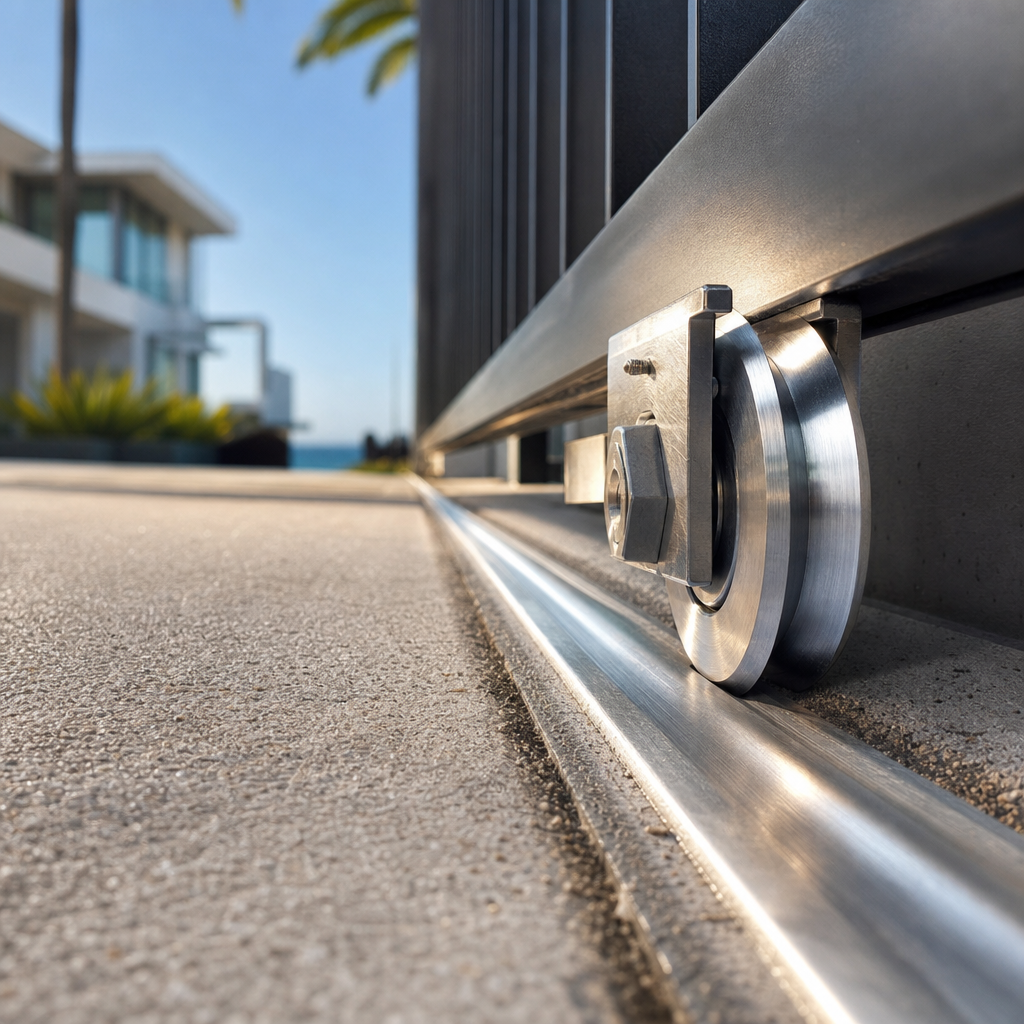
Hardware selection directly affects long-term maintenance and system reliability.
Ground Tracks vs Heavy-Duty Hinges
Traditional v-groove sliding gates rely on an inverted metal track anchored directly into the concrete driveway. In areas where debris accumulates, dirt and grit can collect against the track, wearing down roller wheels over time. A cantilever sliding system avoids this by suspending the gate from a roller carriage, keeping moving parts elevated above the driveway surface.
Swing gates bypass ground tracks altogether, but they place continuous rotational stress on the hinge posts. Heavy gates require durable, greaseable ball-bearing hinges welded directly to reinforced posts set deep in concrete to prevent posts from leaning and gate panels from sagging.
| Hardware Factor | Sliding Gate System | Swing Gate System |
|---|---|---|
| Debris Exposure | Higher on track systems; low on cantilever setups | Minimal, hardware stays elevated off the ground |
| Mechanical Stress Points | Guide rollers, bottom wheels, and drive chain tension | Hinge pins, bearing races, and post footings |
Matching Motor Capacity to Gate Weight and Site Conditions
Need sliding vs swing gate?
We’re available now - call for a fast, free estimate.
Undersizing a gate motor leads to frequent overheating, slow travel speeds, and mechanical failures. Solid gate panels can act like a sail during strong winds. If an operator lacks sufficient torque, wind resistance will trip internal overload sensors, stopping the gate halfway across the driveway. According to installation teams at Ironworks Gate Co., calculating gate weight, surface solidness, and wind drag ensures smooth, reliable operation.
Groundwork, Concrete, and Electrical Factors
Total project costs depend on the amount of civil excavation, electrical trenching, and structural work required for your driveway layout. Swing gates are typically less expensive to install on flat properties because they require less groundwork. Sliding gates, however, often involve concrete pad construction for the track and motor, along with electrical conduit trenching along the side fence.[3]
Underground infrastructure is critical for system durability. Sliding gates require a level concrete footer running the entire length of the track to prevent the gate from binding as it rolls. If retrofitting an existing driveway, concrete cutting and trenching for power lines and safety devices must be factored into project planning.
Frequently Asked Questions About Driveway Gates
Which is cheaper to install: a sliding gate or a swing gate?
On a level driveway, a swing gate is generally cheaper to install because it requires less structural groundwork. Sliding gates require a poured concrete footing along the entire path of travel, track hardware, and extended electrical wiring, which adds to the initial labor and material costs.[4]
Which gate holds up better on steep slopes?
Sliding gates are often better suited to steep or space-constrained sites. Because the gate moves sideways along the fence line, it avoids the rising driveway grade that can cause inward-swinging gates to scrape the pavement.
Are sliding gates more secure than swing gates?
Sliding gates are generally more resistant to forced entry. When closed, the leading edge of a slide gate locks directly into a deep steel catch post, making it difficult for an intruder to push open with a vehicle. Swing gates rely on mechanical arm resistance or a magnetic lock, which can be vulnerable to high-leverage forced entry if not properly reinforced.
What happens if the power goes out?
Automated gate systems include an emergency manual release. For swing gates, this is typically a release lever on the articulated arm that allows you to push the gate open by hand. For sliding gates, a manual bypass disconnects the drive chain or motor gearbox so the panel can slide freely.
As emphasized by Ironworks Gate Co., evaluating driveway slope, clearance, and safety requirements will help ensure you choose the best gate design for your property.
Need sliding vs swing gate?
We’re available now - call for a fast, free estimate.
Sources
- Powered Gates Market Research Report 2034 – dataintelo.com (2034)
- Electric Gate Openers Market Research Report 2034 – dataintelo.com (2034)
- Heavy Duty Gate Openers Market Research Report 2034 – dataintelo.com (2034)
- Gate Openers Market Size & Growth | Industry Forecast [2034] – fortunebusinessinsights.com (2034)
- Metal Driveway Gates Market Research Report 2034 – dataintelo.com (2034)
Frequently Asked Questions
How do high coastal winds affect the choice between sliding and swing gates?
Solid swing gates act like sails and place intense rotational stress on hinges and motor arms during high winds, often triggering safety overload stops. Sliding gates handle lateral wind loads more reliably because the panel is secured within fixed guide rollers and a catch post. Ironworks Gate Co. recommends sliding systems or heavy-duty commercial operators for hillside and coastal properties subjected to frequent gusts.
How much extra lateral clearance is needed for a cantilever sliding gate compared to a standard track gate?
While a standard track sliding gate needs side clearance equal to the opening width plus roughly 2 to 4 feet, a cantilever system requires an additional 30% to 50% of the opening width for its counterbalance tail. For example, a 14-foot driveway opening typically requires 20 to 22 feet of unobstructed linear fence line. Property owners can schedule a free on-site gate assessment with Ironworks Gate Co. to measure exact clearances and evaluate property setbacks.
How does coastal salt air affect sliding and swing gate hardware over time?
Marine environments accelerate corrosion, which can cause in-ground metal tracks to pit and standard steel hinge pins to seize. Swing gates with greaseable stainless-steel ball-bearing hinges or suspended cantilever systems with protected internal rollers hold up best against coastal air. Backed by 42 years of coastal Orange County experience, Ironworks Gate Co. advises using marine-grade powder coating and sealed hardware to prevent salt-induced mechanical failure.
About the author
 |
Sarah O’Connor Sarah is a technical writer specializing in home security and access control systems. With over eight years of experience writing for property management and contractor publications, she translates complex mechanical and electrical concepts into clear, actionable advice. She holds a B.A. in Communications from California State University, Fullerton, and frequently consults with certified gate technicians to ensure her content is accurate and practical. |
Gate not opening, off track, or opener dead?
We’re available now - call for a fast, free estimate.
Call Now - Free Estimate