
Quick Summary
When an automated driveway gate fails to open or close, systematic electric gate troubleshooting is essential to identify whether the breakdown stems from electrical disruptions, sensor misalignment, or mechanical binding. While basic breaker resets and lens cleaning are safe for homeowners, the specialists at Ironworks Gate Co. emphasize that issues involving motor capacitors, internal gearboxes, and sagging hinges require certified technical repair. Reading this guide will help you accurately isolate common gate malfunctions, execute safe manual release procedures during power outages, and know when to schedule a professional on-site assessment.
Electric Gate Troubleshooting – Fast Fixes for Driveway Gates
When an automated driveway gate stops moving, diagnosing the problem methodically saves hours of frustration. As a general best practice, troubleshooting begins by understanding that automatic gate operators rely on a balance between incoming electrical current, safety sensor feedback loops, and mechanical drive components. A failure in any single part of that chain can bring the system to a stop.[3]
While standard manuals cover typical mechanical and electrical faults, field technicians at Ironworks Gate Co. also report anecdotal observations regarding environmental factors in coastal and high-humidity areas, such as salt deposits or fog affecting optical sensors. This general guide outlines practical diagnostic best practices to help isolate electrical, mechanical, and sensor faults safely across typical installations.
Fast Diagnostics: What to Check When Your Electric Gate Stops Working
Fast Diagnostics in brief: As general best practice to troubleshoot an electric gate that will not open or close, check your main subpanel breaker and GFCI outlet first. Next, look at the diagnostic LEDs on your safety photo-eyes, clear the physical track or swing radius of debris, replace remote transmitter batteries, and check the motor control box for blown low-voltage fuses before attempting a manual release.
When a gate leaves your vehicle trapped in the driveway, run through this general diagnostic sequence before taking tools to the operator housing:
Immediate Safety Checks
Automated gates carry serious force. According to the Consumer Product Safety Commission (CPSC), automatic gates accounted for an estimated 1,500 emergency-room injuries total between 2011 and 2015 (about 300 injuries per year). Furthermore, safety authorities like the Door and Hardware Federation (DHF) and the Health and Safety Executive (HSE) warn that powered gates create severe entrapment and crush hazards if safety devices are bypassed or unmaintained. Before touching any hardware:[1]
- Keep people and pets completely clear of the gate travel path.
- Never attempt to force an operator arm or push a chain-driven gate while power is actively connected.
- Visually check that the gate has not jumped its track or pulled loose from its mounting posts. A 2024 ASTM report highlighted that California OSHA documented 47 work-related accidents, resulting in 35 injuries and 12 deaths, from fence gates derailing and falling between 1990 and 2024.
System Power and Key Reset Steps
- Check the high-voltage feed: Locate the dedicated breaker in your electrical panel and verify it has not tripped. Test the reset button on the inline GFCI outlet feeding the gate operator.
- Inspect low-voltage fuses: Open the operator control box and check the low-voltage fuses on the main control board protecting the auxiliary circuits.
- Test the master reset: Turn off the AC power disconnect switch inside the chassis, disconnect the backup battery harness, wait for the capacitors on the board to discharge, and reconnect power according to manufacturer guidelines.
- Check input triggers: Verify whether the issue is isolated to a single remote, a wireless keypad, or the hardwired push button inside the house.
Quick Comparison: Common Electric Gate Symptoms and Likely Causes
Identifying whether a breakdown stems from an electrical signal disruption or physical resistance helps narrow down the cause before making mechanical or electrical adjustments.
| Diagnostic Focus | Safety Photo-Eyes | Motor & Gearbox | Track & Hardware |
|---|---|---|---|
| Primary Symptom | Gate sensor clicking/beeping, gate opens but will not close | Motor hums or buzzes, arm vibrates, zero gate movement | Gate drags, chatters, stops mid-cycle, or moves unevenly |
| Probable Root Cause | Beam misalignment, dirty lens, moisture, or dead emitter | Failed start/run capacitor, stripped gearbox gears, or low line voltage | Worn roller bearings, ground settling, debris in track, or dry hinges |
| DIY Safe vs Pro Required | Safe for homeowners (cleaning lenses, adjusting bracket alignment) | Professional recommended (high voltage, internal gear assemblies) | Safe for basic clearing; Pro required for post structural repair |
1. Gate Fails to Open or Close: Breaker, GFCI, and Main Power Issues
A completely unresponsive operator usually indicates a loss of primary power or a shutdown triggered by a safety loop.
Diagnosing Power Interruption at the Subpanel
Outdoor gate operators require steady, adequate power. Measure across the high-voltage input terminals with a multimeter to verify voltage matches the operator’s nameplate requirements. If the voltage drops significantly under load, long underground wire runs from the subpanel may be experiencing excessive voltage drop.[2]
Check the GFCI outlet inside or near the operator enclosure. Moisture intrusion or irrigation can trip sensitive GFCI receptacles even when the main breaker remains on.
How to Reset an Automatic Gate Opener System
Microprocessor control boards can freeze during sudden power fluctuations. As a general reset procedure:
- Switch off the dedicated AC circuit breaker feeding the operator.
- Disconnect the battery backup harness.
- Leave all power disconnected briefly to allow residual energy on the board to dissipate.
- Reconnect the battery terminals and restore main AC power.
- Initiate an open command to allow the unit to cycle.
2. Gate Motor Hums but Does Not Move: Capacitor and Gearbox Faults
Need electric gate troubleshooting?
We’re available now - call for a fast, free estimate.
If the motor produces an audible hum or buzz when triggered but the drive mechanism remains motionless, the issue is often related to the starting circuit, drive assembly, or mechanical binding.
Testing the Start/Run Motor Capacitor
Single-phase AC gate motors typically rely on an external run/start capacitor to provide the necessary starting torque. When a capacitor fails or degrades, the motor hums without turning and may trip its thermal overload switch.
To safely test the capacitor:
- Disconnect all AC power to the machine.
- Safely discharge the capacitor terminals using appropriate insulated tools and discharge resistors.
- Disconnect the leads and test the component using a multimeter with a capacitance setting. If the reading is outside the manufacturer’s specified tolerance printed on the case, replace it.
Internal Operator Gearbox and Drive Sprocket Inspection
If the electrical components test normal, disengage the drive mechanism and inspect the output shaft. Internal gears can wear or strip over years of heavy use. If the electric motor runs freely when disconnected from the drive load but binds when connected, the internal gearbox or drive linkage may require professional servicing.[4]
3. Gate Sensor Beeping and Auto-Reversing: Photo-Eye Misalignment
Automated gate systems incorporate monitored external entrapment protection devices. If the receiver photo-eye does not detect its matching beam while the gate is closing, the control board halts and reverses movement to prevent entrapment.
Reading Safety Sensor Diagnostic LEDs
Inspect the indicator LEDs on the photo-eye modules:
- Solid Indicator: Generally indicates normal power and proper optical alignment.
- Flashing / Flickering: The sensor may be marginally aligned or obstructed.
- Unlit: Indicates a loss of power or broken low-voltage field wiring.
Anecdotal Observation: Coastal Fog and Salt Exposure
Field technicians frequently report anecdotal observations in coastal environments where heavy morning marine fog and salt accumulation appear to scatter optical beams or cause premature sensor reversal. While independent empirical studies are limited, general field maintenance recommends keeping lenses clean with a microfiber cloth, ensuring brackets are securely aligned, and utilizing protective weather hoods over sensor housings.
4. Gate Opens or Closes on Its Own: Loop Detectors and Keypad Shorts
Unintended gate cycling presents security and safety concerns and should be addressed promptly.
Underground Exit Loop Sensitivity Adjustments
In-ground inductive loops detect frequency changes when a vehicle passes over their magnetic field. However, several factors can cause false triggers:
- High sensitivity settings: If loop detector sensitivity is set too high, nearby moving metal or environmental interference can trigger a call. Lower the sensitivity setting slightly.
- Moisture intrusion: Water pooling in unsealed pavement cuts can alter inductance. Inspect loop saw cuts and reseal cracked sealant as needed.
Keypad Contacts and Environmental Corrosion
Moisture and environmental residue on access keypads, push buttons, or control terminals can create unintended short circuits or resistance drops that trigger open commands.
Inspect keypad backplates and board terminals for corrosion or moisture deposits. Clean contacts with appropriate electrical contact cleaner and ensure enclosures are properly sealed.
5. Sliding Gate Jams and Drags: Track Obstructions and Worn Rollers
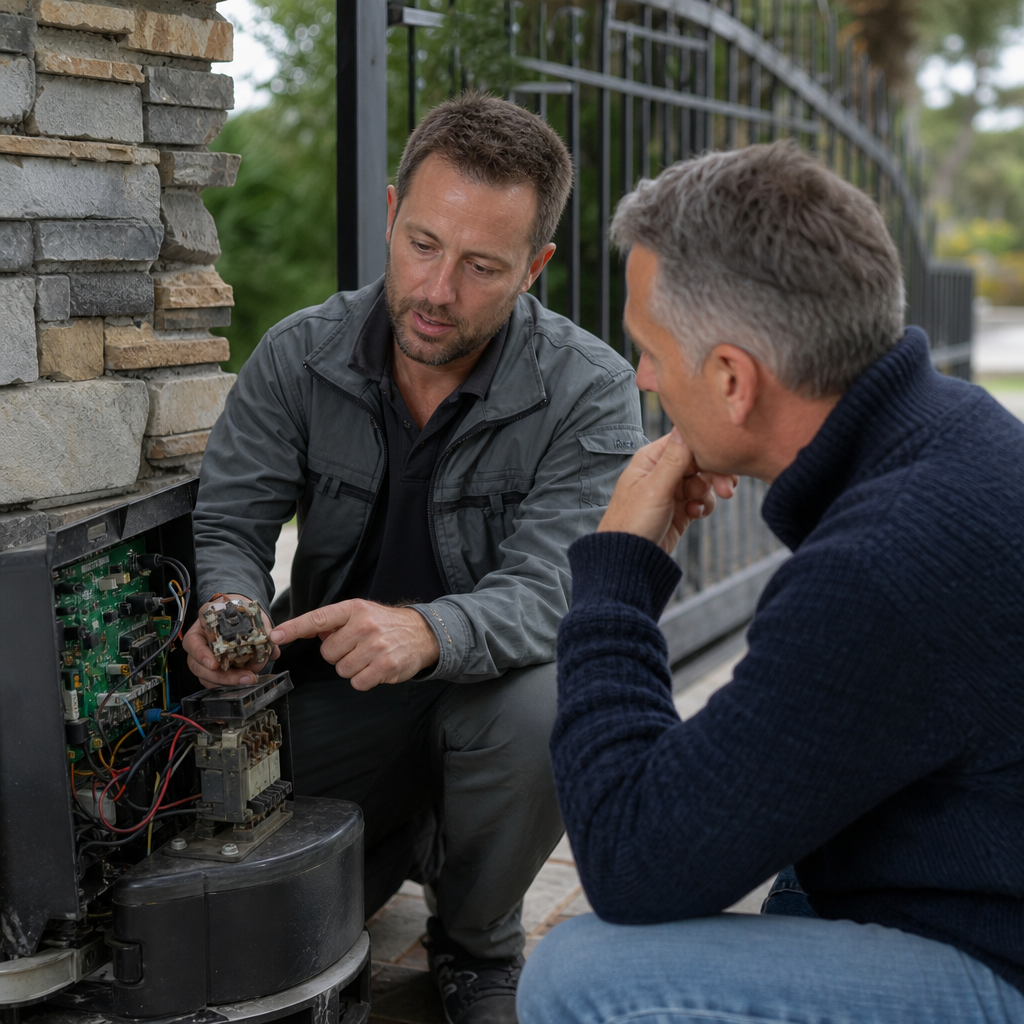
Sliding gates depend on minimal rolling resistance. Physical obstruction or worn hardware increases motor load, causing the operator to stall or reverse.
Track and Roller Inspection
Ground tracks collect gravel, dirt, and debris. Clean the track along its full travel path and inspect roller bearings. Worn or seized bearings create excessive friction, accelerating wear on the motor and drive mechanism.
Chain Drive Tensioning and Derailment Dangers
Proper chain tension is necessary for reliable operation and derailment prevention. A loose chain can jump drive sprockets or snag, increasing the hazard of derailment. Inspect chain links for wear or corrosion and adjust tension according to the manufacturer’s installation guidelines.
6. Swing Gate Sags or Stops Mid-Swing: Hinge Wear and Limit Switch Faults
Swing gates exert substantial leverage on hinge posts, making sound structural alignment critical, as specialists at Ironworks Gate Co. note.
Hinge Drag and Post Alignment
Settling posts or worn hinge pins cause gate leaves to sag, creating heavy mechanical resistance against the operator arm.
To test, disengage the operator and swing the gate manually. If binding or excessive resistance is felt, lubricate the hinges or realign mounting hardware before making adjustments to motor force settings.
Adjusting Limit Switches
If the gate moves freely by hand but stops prematurely, limit switch components may require adjustment:
- Magnetic limits: Ensure target magnets on the rack or actuator have not shifted or accumulated magnetic debris.
- Mechanical limits: Inspect microswitches and adjustment cams inside the operator housing to ensure they remain tightly fastened and properly positioned.
7. Electrical Connection and Wiring Diagnostics
Need electric gate troubleshooting?
We’re available now - call for a fast, free estimate.
Control circuits require stable electrical connections to process inputs from safety sensors and control accessories reliably.
Inspecting Wiring and Terminals
Check the low-voltage supply to accessories with a multimeter against system specifications. If voltage fluctuates or drops significantly, inspect splices and terminal connections. Corroded wire splices in underground junction boxes can create high-resistance faults that cause intermittent operation.
Protecting Control Enclosures
Insects, pests, and moisture entering control enclosures can damage circuit boards. Ensure conduit entries are sealed with duct seal putty and check that enclosure weather gaskets remain intact.
8. How to Manually Disengage an Electric Driveway Gate During Power Outages
When power fails, manual release allows you to move the gate safely.
Swing Arm Quick-Release Procedures
- Turn off power to prevent accidental motor activation.
- Insert the manufacturer-provided release key into the lock on the actuator arm or operator housing.
- Turn the key and disengage the manual release lever or pin according to the operator manual.
- Move the gate slowly by hand and secure it open to prevent wind from swinging it unexpectedly.
Sliding Operator Mechanical Release
- Open the manual release access compartment using the operator key.
- Disengage the clutch handle or turn the release knob as instructed by the manufacturer.
- Slide the gate open manually, confirming it remains securely retained by its guide rollers.
Major Gate Automation Brands and Service Considerations
While general troubleshooting principles apply broadly, specific brands (such as LiftMaster, DoorKing, Viking Access, and Nice Apollo) utilize distinct diagnostic interfaces, status indicators, and board architectures. Always consult the specific manufacturer documentation and technical manuals for authoritative fault code definitions, board diagrams, and model-specific configuration steps.
Electric Gate Troubleshooting and Repair Considerations
Understanding the distinction between routine maintenance and complex repairs protects safety and equipment reliability.
Professional Repair vs. DIY Maintenance
Routine tasks such as clearing tracks, wiping sensor lenses, replacing remote batteries, lubricating hinges, and performing basic power resets are suitable for property owners. However, high-voltage electrical repairs, internal gearbox rebuilds, capacitor replacements, and structural post realignments involve significant hazards and should be handled by qualified professionals like Ironworks Gate Co.
Repair vs. Full Operator Replacement Considerations
If an operator is aging, lacks modern monitored entrapment safety features, or shows severe corrosion, replacing the unit may be more cost-effective and safer than extensive component repairs.
Frequently Asked Questions About Electric Gate Troubleshooting
Why is my electric gate not opening or closing?
Common causes include a tripped breaker, a triggered GFCI outlet, weak transmitter batteries, mechanical track obstructions, or misaligned safety photo-eyes. Verify power, check sensor status lights, and inspect the travel path for physical blockages.
How do I reset an automatic gate opener system?
Disconnect AC power and the backup battery system, wait briefly for the board circuitry to discharge, and then reconnect the system according to manufacturer instructions.
Why is my electric gate motor humming but not moving?
A humming motor without movement usually indicates a failing start capacitor, internal gearbox binding, or physical resistance along the gate track or hinges.
How do I troubleshoot electric gate photo eye sensors?
Inspect the indicator LEDs on each sensor. A solid light normally confirms alignment, while flashing or dark lights suggest misalignment, wiring faults, or dirty lenses. Keep lenses clean and brackets aligned.
What causes an electric gate to open or close on its own?
Ghost cycling is typically caused by oversensitive loop detectors, shorted keypad or button wiring, or environmental moisture and corrosion across control board terminals.
How do I manually open an electric driveway gate during a power outage?
Disconnect power, unlock the manual release mechanism with the operator key, disengage the drive clutch or release pin, and carefully move the gate by hand, securing it against wind movement.
Need electric gate troubleshooting?
We’re available now - call for a fast, free estimate.
Sources
- AB 2149 (Connolly) – sjud.senate.ca.gov (2026)
- [PDF] 2024-11-20-COPF-CODD-Hummingbird-Alliance-Meeting-Log.pdf – cpsc.gov (2024)
- New Safety Standard for Automatic Security Gates Helps … – cpsc.gov (2000)
- National Electronic Injury Surveillance System (NEISS) – CPSC – cpsc.gov
Related reading: Automatic Gate Repair – Call Now-10% Off – On-Site in 60 Minutes – Free Estimate
Related reading: Sliding Vs Swing Gate – Call Now-10% Off – Same-Day Service – Free Estimate
Related reading: Gate Sensor Repair | Call Now-10% Off | On-Site in 60 Minutes | Free Estimate
Frequently Asked Questions
How does coastal weather affect electric gate sensors and what prevents false reversals?
Salt air and dense marine fog can scatter infrared beams or corrode low-voltage terminals, causing safety sensors to trigger false reversals. Installing protective weather hoods, regularly wiping lenses with a microfiber cloth, and having Ironworks Gate Co. seal conduit enclosures will keep optical safety loops reliable in coastal climates.
How can I tell if my gate operator needs a simple capacitor replacement or a new motor?
If the electric motor hums without turning and tests below its rated microfarad rating on a multimeter, replacing the start/run capacitor usually solves the issue. However, if the motor housing overheats, trips the main breaker instantly, or binds when disconnected from the gate load, Ironworks Gate Co. recommends scheduling a technical assessment for internal gearbox or motor replacement.
How often should an electric driveway gate receive professional diagnostic servicing?
Residential automated gates should undergo comprehensive professional servicing at least once a year, or bi-annually for high-cycle and coastal properties. Routine maintenance by specialists like Ironworks Gate Co. ensures safety entrapment sensors are properly calibrated, hinge wear is corrected before sagging occurs, and drive chains maintain proper tension.
About the author
 |
Sarah O’Connor Sarah is a technical writer specializing in home security and access control systems. With over eight years of experience writing for property management and contractor publications, she translates complex mechanical and electrical concepts into clear, actionable advice. She holds a B.A. in Communications from California State University, Fullerton, and frequently consults with certified gate technicians to ensure her content is accurate and practical. |
Gate not opening, off track, or opener dead?
We’re available now - call for a fast, free estimate.
Call Now - Free Estimate