
Quick Summary
When an automated driveway gate hums without moving or stalls mid-cycle, a degraded gate motor capacitor is often the underlying issue preventing the motor from generating sufficient starting torque. Accurately diagnosing a gate motor capacitor requires safely discharging stored electrical energy and testing microfarad levels with a digital multimeter against exact manufacturer tolerances rather than replacing the entire operator. This guide equips property owners to recognize key failure symptoms, follow safe electrical testing procedures, and contact Ironworks Gate Co. for precise same-day diagnostic assessments.
Gate Motor Capacitor: Diagnostic and Repair Guide
When an automated driveway gate hums, stalls mid-cycle, or refuses to move, a degraded gate motor capacitor may be involved. This component stores and releases electrical energy to help single-phase AC motors start and run.
Disclaimer: Capacitor symptoms overlap significantly with mechanical, electrical, and motor faults, so diagnosis should not rely on symptoms alone. Below is a guide to identifying potential capacitor issues and safely performing diagnostic checks. See also Automatic Gate Not Working – Call Now-10% Off – Same-Day Service – Free Estimate.
Gate Motor Capacitor Issues: Quick Diagnosis and Overview
As specialists at Ironworks Gate Co. explain, if you trigger your gate opener and hear an audible electrical hum from the operator box while the gate does not move, the motor may be attempting to start without sufficient torque.
Why Is My Gate Motor Humming but Not Moving?
Single-phase AC gate motors rely on a capacitor to shift the electrical phase between start and run windings, generating the torque needed to turn the rotor. When a capacitor fails or falls out of specification, the motor may receive power and hum without rotating.
According to the Alabama Cooperative Extension System, motor capacitors fail due to normal wear, lightning strikes, power surges, motor deficiencies, or incorrect capacitance, voltage, or frequency ratings.[1]
Common Symptoms of a Bad Gate Motor Capacitor
Humming, slow starting, intermittent operation, stalling, or visible capacitor damage can indicate a capacitor problem, though these symptoms have other possible causes:
- Humming: The operator engages and the motor hums, but the drive mechanism remains stationary.
- Slow starting or stalling: The gate starts slowly, hesitates, or stalls during its cycle.
- Intermittent operation: The gate functions inconsistently across different operating cycles.
- Visible damage: Swelling, leaking, or physical damage on the capacitor casing.
- Assisted starting: If manually assisting the gate helps it begin moving, this may be consistent with capacitor trouble, but it is not diagnostic on its own.
Safety Warning: Capacitors store electrical charges after power is disconnected. Always isolate power, verify the absence of power, and safely discharge stored energy before handling components. If you are unfamiliar with the procedure, consult a qualified technician.
What Does a Gate Motor Capacitor Do and Why Does It Fail?
In single-phase AC gate operators, capacitors provide the phase displacement necessary to create starting and running torque.
Start Capacitors vs. Run Capacitors in Gate Openers
Depending on the design of the operator, the motor may use a start capacitor, a run capacitor, or both:
| Capacitor Type | Primary Function |
|---|---|
| Start Capacitor | Supplies torque to help the motor start from a standstill |
| Run Capacitor | Helps maintain operating torque and smooth motor operation |
Capacitor Degradation
Capacitors may exhibit visible signs of failure, such as bulging or fluid leaks, or they may degrade over time while appearing normal externally. Supported causes of failure include normal wear, lightning strikes, power surges, motor deficiencies, and incorrect capacitance, voltage, or frequency ratings.
How to Test a Gate Opener Capacitor with a Multimeter
Need gate motor capacitor?
We’re available now - call for a fast, free estimate.
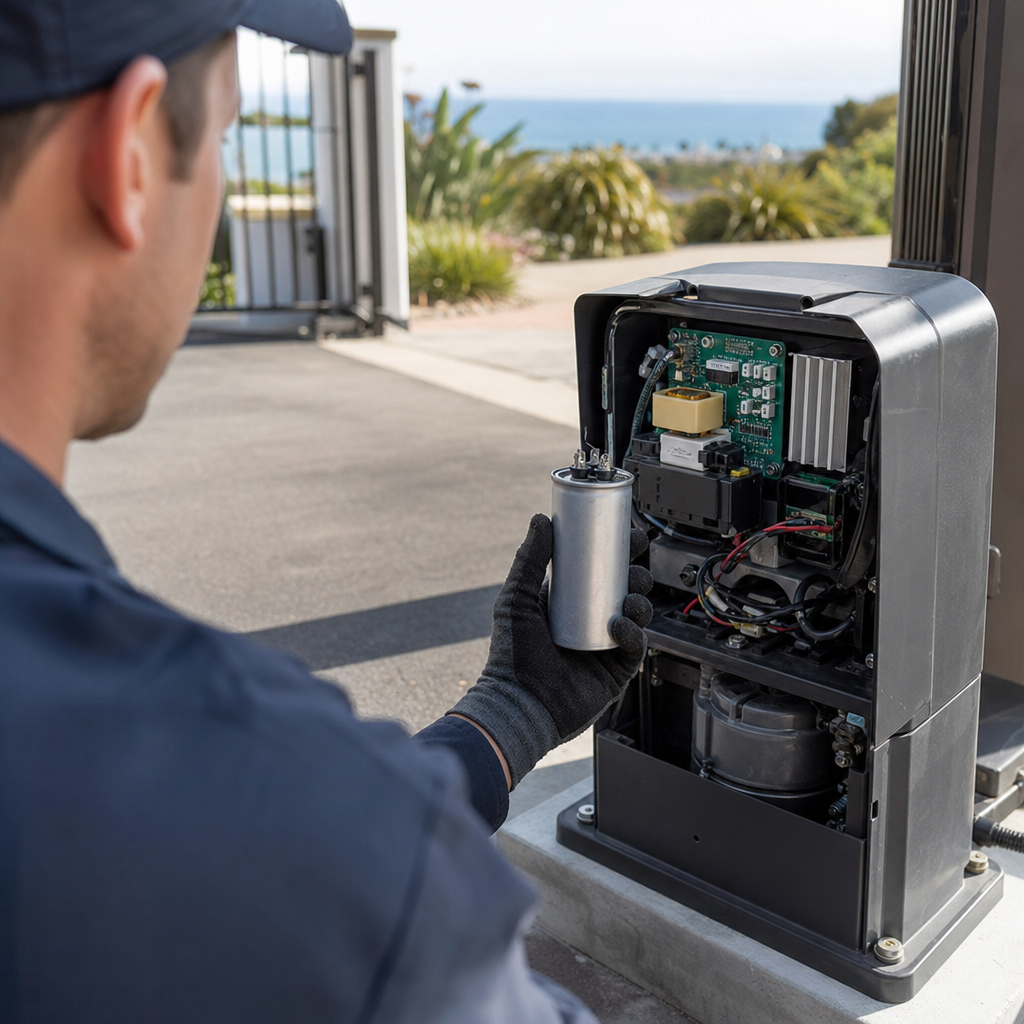
Testing with a digital multimeter equipped with a capacitance setting provides a diagnostic check to evaluate the condition of the capacitor.
Safety Protocol
- Isolate power: Disconnect all electrical power to the gate operator.
- Verify absence of power: Confirm that no voltage is present at the unit.
- Discharge stored energy safely: Safely discharge any electrical charge remaining in the capacitor.
- Disconnect wiring: Disconnect the capacitor from the circuit to ensure an isolated measurement.
- Use a qualified technician: If you are unfamiliar with the procedure, have a qualified technician perform the work.
Reading Microfarads (µF) and Tolerance Thresholds
- Set the multimeter to the capacitance setting (µF or MFD).
- Connect the meter leads across the capacitor terminals.
- Allow the meter to stabilize its measurement.
- Compare the measured value with the labeled microfarad rating and the manufacturer tolerance printed on the capacitor.
If the measured capacitance falls outside the manufacturer-specified tolerance, the capacitor should be replaced.
Gate Operator Capacitor Replacement Considerations
According to Ironworks Gate Co., when replacing a capacitor, avoid universal replacement assumptions. Always consult the operator manual and match the manufacturer-specified capacitance, voltage, and frequency requirements.
Frequently Asked Questions About Gate Motor Capacitors
How do I know if my gate motor capacitor is bad?
Humming, slow starting, intermittent operation, stalling, or visible damage can indicate a capacitor problem. However, because these symptoms overlap with mechanical and electrical faults, diagnosis should not rely on symptoms alone. A multimeter diagnostic check comparing the measured capacitance to the labeled rating and manufacturer tolerance helps determine its condition.
Can a faulty capacitor affect my gate opener motor?
Yes. An incorrect or failing capacitor can lead to improper motor starting, stalling, or motor deficiencies.
How do I choose the right replacement capacitor for my gate motor?
Always consult the operator manual and match the manufacturer-specified capacitance, voltage, and frequency requirements.
Can I replace a gate motor capacitor myself?
A capacitor can be replaced if proper safety guidance is followed: isolate power, verify absence of power, and safely discharge stored energy. If you are unfamiliar with the procedure, contact a qualified technician such as Ironworks Gate Co.
Need gate motor capacitor?
We’re available now - call for a fast, free estimate.
Sources
- Motor Repair Tech Brief – energy.gov
Related reading: Electric Gate Manual Override – 10% Off & Free Estimate – Same-Day Service
Related reading: Sliding Gate Maintenance | Call Now-10% Off | Same-Day Service | Free Estimate
Related reading: Automatic Gate Not Opening | 10% Off & Free Estimate | Same-Day Service
Frequently Asked Questions
Can replacing a bad capacitor save me from buying an entirely new gate operator?
Yes, accurately identifying and replacing a degraded capacitor restores necessary starting torque and prevents costly, unnecessary motor replacements. Ironworks Gate Co. provides fast same-day diagnostics to verify exact microfarad ratings and save property owners from buying new operators prematurely.
How does coastal marine moisture affect gate motor capacitor lifespan?
Salt air and humidity accelerate internal dielectric breakdown and terminal corrosion within operator enclosures, causing capacitors to fall out of manufacturer tolerance faster than normal wear. Regular capacitance checks help identify these moisture-related drops before the motor stalls or overheats.
Why is it dangerous to test or replace a gate motor capacitor without discharging it first?
Capacitors retain high-voltage electrical charges long after power is disconnected, creating a severe electrical shock hazard and potentially damaging multimeter testing equipment. Safe discharging isolates the component, ensuring precise microfarad readings and safe handling during service.
About the author
 |
Sarah O’Connor Sarah is a technical writer specializing in home security and access control systems. With over eight years of experience writing for property management and contractor publications, she translates complex mechanical and electrical concepts into clear, actionable advice. She holds a B.A. in Communications from California State University, Fullerton, and frequently consults with certified gate technicians to ensure her content is accurate and practical. |
Gate not opening, off track, or opener dead?
We’re available now - call for a fast, free estimate.
Call Now - Free Estimate